

Make Restaurants Magical Again
In which I reminisce about the "experience" restaurants in my past, and argue that we might want to bring a little theater back into dining out.

The earliest restaurant memory I have is the following: I was a kid- probably 7 or 8- and we were eating at a restaurant while on a road trip through central California. At some point during the meal, the waitress came up to the table and said “come with me”. I was dazzled and a little freaked out- it was rare that an adult stranger spoke to me directly. I looked to my parents, and they had smiles on their faces, so I figured it was all right. The waitress took me by the hand and walked me across the restaurant, away from my parents and brother. We stopped in front of a wee square door I hadn’t seen before- it was the size of a child, no bigger: my parents could not have squeezed through it. The waitress bent over, opening the door, and looked me straight in the eye. She said, kindly, “You may take one.”
I looked inside and felt I was peering through a portal. It was a tiny room, decorated as if it were an undersea scene: the walls were painted blue with images of fish and seaweed, the light was filtered and aquamarine. Coral was strewn around the edges of the room, and sand was on the floor. In my memory, there was an eerie music playing (I think this part is probably my imagination, but stay with me). In the middle of the room sat a real treasure chest. Emboldened, I crawled toward the chest and opened it- and it was filled with toys. As instructed, I took one- it was a little metal rocket that you could put caps in. I scrambled out of the undersea room and returned to the table, beaming with excitement.
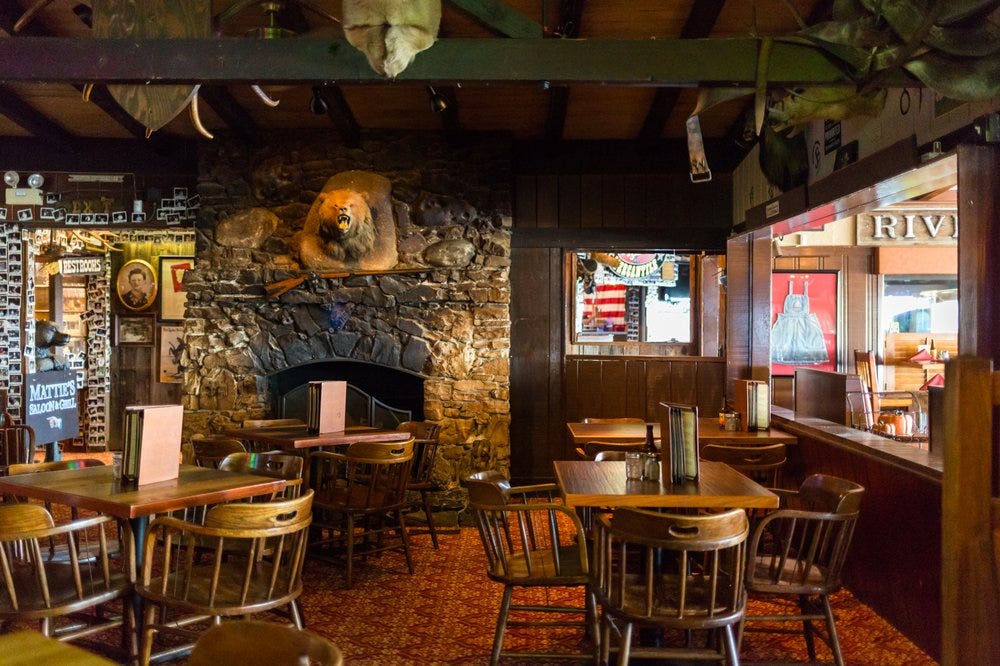
This happened perhaps fifty years ago, but I remember the event with perfect clarity. I have told innumerable people this very story. Later, I learned the restaurant was named F. McLintock’s, a Pismo Beach wild-west themed “Saloon and Dining House”. The place had a 50 foot wooden cowboy in the front, a giant neon sign, taxidermied bears and buffalos inside, and the servers were famous for pouring water blindfolded from an amazing height into a glass held upon a diner’s head. They served high-quality steaks, ribs, chicken and seafood, but it was all part of a magical beachside circus-meets-old west experience. To a kid like me, it was completely memorable.
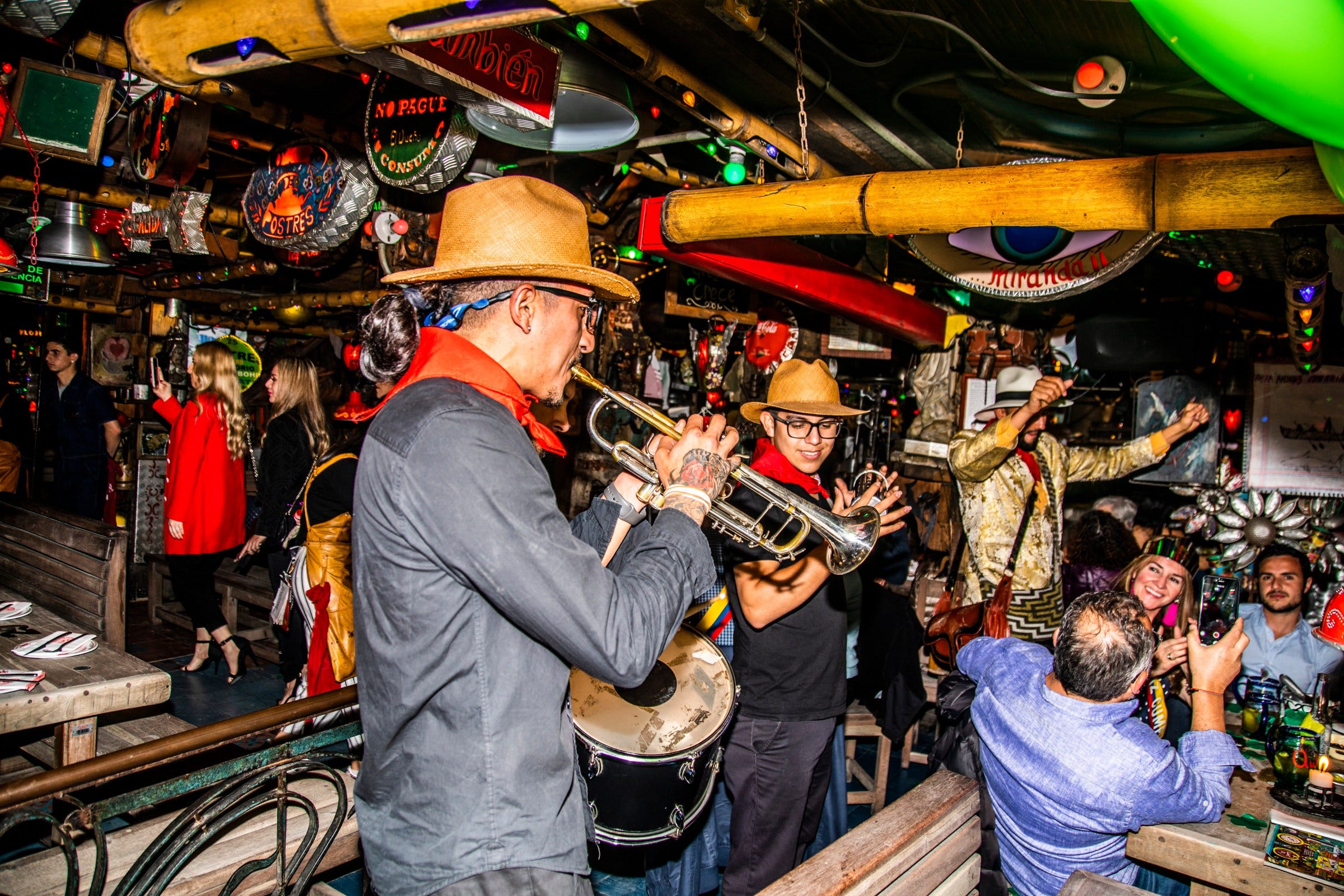
I had to wait thirty years to have a similar experience, and it was at a restaurant 45 minutes outside of Bogota, Colombia. That place was Andrés Carne De Res, a sprawling two-and-a-half-square-mile restaurant in the middle of the Colombian countryside. If you’ve been to Andrés, you know what I’m talking about: the place is a full-on multisensory experience of food, drink, performance, dance, décor, and amor. It’s decorated in a cluttered, Latin American outsider-art style, and it’s impossible to describe completely: the food is whimsical and delicious, the vibes are beautiful and zany, and spontaneous parades by the servers and performers spring up at a moment’s notice. I remember the lomo al trapo, steak cooked in a salted, charred cotton cloth, and I remember the beans (I always remember the beans), but what stays with me from that first visit was the feeling of magic- of being transported to another place for a little while.
Food can do that by itself, of course, and it doesn’t take theater. A perfect bite can be transporting, memorable, and magical on its own. But theater doesn’t hurt. Humans have enjoyed entertainment with their meal for thousands of years- from the courts of Medieval Europe and China to the dinner shows of the American midcentury.
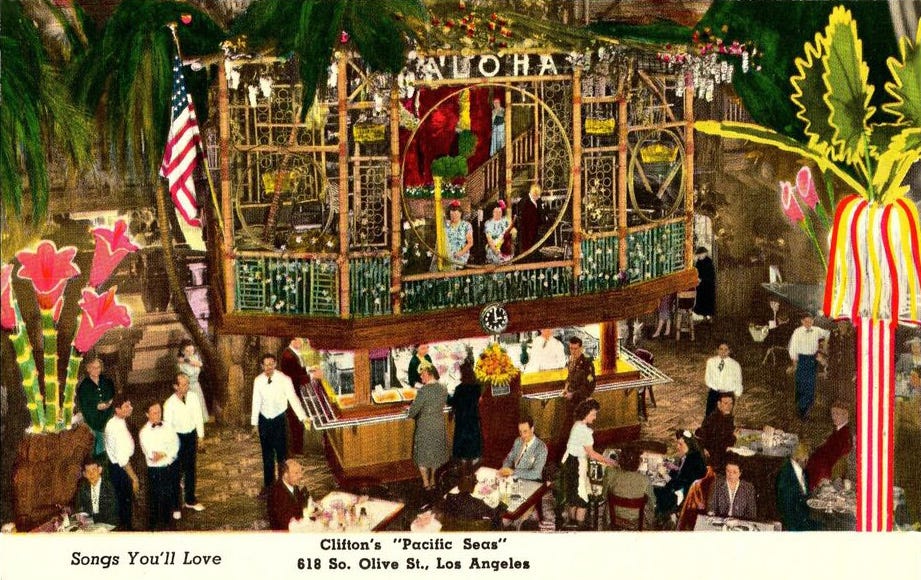
Over the years, innumerable restaurants have sought to create an experience for their diners. My dad fondly remembers Clifton’s Cafeterias in the 1950s, two themed restaurants in Los Angeles which featured indoor Pacific Island rainforests, waterfalls, Californian mountain landscapes, lakes, rivers, and the motto “Dine Free Unless Delighted.” Delighted my dad was- he still tells me about childhood birthday parties there.
There were other “magic” restaurants: Farrell’s, an ice cream parlor done in a 1900s style with zany concoctions like a hot fudge volcano with fireworks in the top (and a siren when it emerged from the kitchen!) was fantastic; the Tonga Room, a Polynesian themed restaurant in San Francisco with its indoor lagoon and artificial rainstorms is legendary (it still exists!).
But, aside from Andrés Carnes De Res (which is expanding into other cities), most of these restaurants have vanished, are closing or declining. How come?
Well, I fear the theme restaurant concept went through a rough patch in the 80s and 90s. Chuck E. Cheese Pizza Time Theater integrated video arcades and robotic entertainment, Rainforest Cafe created animal-themed forests with, again, robotic entertainment, Planet Hollywood and Hard Rock Cafe built more adult-oriented entertainment restaurants, and Medieval Times created the Knight’s Tourney and Banquet themed dinner. All of these concepts, sadly, leaned much harder on the theme than on the food, serving forgettable, industrial food in what seemed to be a gimmicky- rather than truly fun- environment. Cynical, ironic Gen X diners like myself began to see the theme restaurant as inauthentic and artificial, not fun and magical. My generation stayed away in droves. Meanwhile, the old-school experience restaurants forgot about the food too, competing on theater alone. Theme restaurants began closing, and fast.
And in its place came the 21st century restaurant movement. During this period dining became, more than ever, an expression of ethics, good taste, and social class. The farm-to-table movement took its food seriously, situating it in an ethos of sustainability and authenticity. Restaurants employed chefs as artistes, honoring ingredients and producers, with an earnest, reverent atmosphere. The Michelin guide- originally published for elite French motorists seeking haute cuisine in the European countryside- published its first American edition in 2005, bringing the idea of extreme French-style elegance to the American middle class diner. Suddenly, theme restaurants were completely declassé- an abasement of food instead of a celebration of it, an artificial experience instead of an authentic one. To make matters worse, many of the themes themselves- often based in imagined places and cultures rather than real ones- seemed cringey, even offensive. “Good” restaurants were a serious business: the performance was the farmer’s art and the chef’s skill, and anything else was distraction. Restaurant décor should be minimal, this aesthetic dictated: the magic should be on the plate.
But, let’s be honest, sometimes that magic doesn’t hit. Not every chef is an alchemist, not every farm produces the best-of-the-best. Most restaurants do a fine job, but fail to transport diners with the food alone. Contemporary restaurants still try to toe the line, presenting their dishes with a very very straight face, encouraging diners to pay attention to the food. Alas, it can get kind of boring. A little theater wouldn’t hurt.
What I’m saying is I am yearning for a new era of experience restaurants, ones with good food and good fun,.I want to laugh with my family over shared food- I want to see my kids amazed by spectacle or a small, magical moment. Is that so wrong?
I could be missing something. There might be theatrical, fun, experiential restaurants popping up that I haven’t seen yet. Anyone have an example? What’s your favorite “experience” restaurant?
I might suggest a visit to Nocturne in Denver, Colorado. Taking the art of food, wine pairings, fine dining hospitality and serving it alongside superb live jazz.
I have a similar childhood restaurant memory of eating at Casa Bonita in Fort Worth, Texas. It had a giant indoor waterfall, a ceiling painted like the sky with model airplanes and blimps scooting across it on wires. And my favorite part was the sopapilla-making machine and the little red and green flags you would hoist up miniature poles at your table to signal the waiters you wanted more of the all you can eat Mexican food. I had all but forgotten about that restaurant experience until I read that the creators of South Park had refurbished the original Casa Bonita in Denver for a ridiculous sum of money. Maybe one day I’ll go back and visit that one too.